On May 23, 1943, the North Carolina Ship Building Company, located in Wilmington, North Carolina, launched its 100th Liberty Ship, the S.S. Charles D. McIver. As founder and first president of the State Normal and Industrial School (now The University of North Carolina at Greensboro), and a fierce advocate of public education for women, McIver was a natural choice for a commemorative Liberty Ship. He was one of several North Carolina educators to have this honor. Initially named after notable deceased Americans, the ships names’ eventually included men and women, of all ranks, who were lost in the war. Naming opportunities came to those who raised two million dollars in war bonds.
 |
| The S.S. Charles D. McIver, 1943* |
On the day that the S.S. Charles D. McIver was launched, high-ranking representatives of the Army, Navy, and Marine Corps, along with local dignitaries, gathered for the festivities in Wilmington, which was broadcasted on the radio. The shipyard band played as the newly christened ship slipped into the water. For glamor, Hollywood actress Constance Bennett was in attendance to present the shipyard with an award for its exceptional purchases of war bonds. Launching its first Liberty Ship only hours before the Japanese attack on Pearl Harbor, the Wilmington shipyard was considered one of the best producers of these types of ships in the United States. The yard boasted over 20,000 employees and the ability to deliver up to ten ships per month.
 |
| Actress Constance Bennett (polka dot dress) attends the launching ceremony at the Wilmington Shipyard, May 25, 1943** |
Based on a British design, Liberty Ships were basic cargo vessels built by the United States Maritime Commission during World War II. The first of these “Emergency Cargo” ships was launched on September 27, 1941, with President Franklin Roosevelt in attendance. Named the S.S. Patrick Henry, who is well remembered for his “Give me liberty or give me death” speech, the president expected these ships to bring liberty to Europe and they were dubbed accordingly. Liberty Ships were meant to be quickly and economically mass-produced, with parts manufactured throughout the country and then assembled at shipyards on the east and west coasts, as well as the Gulf of Mexico.
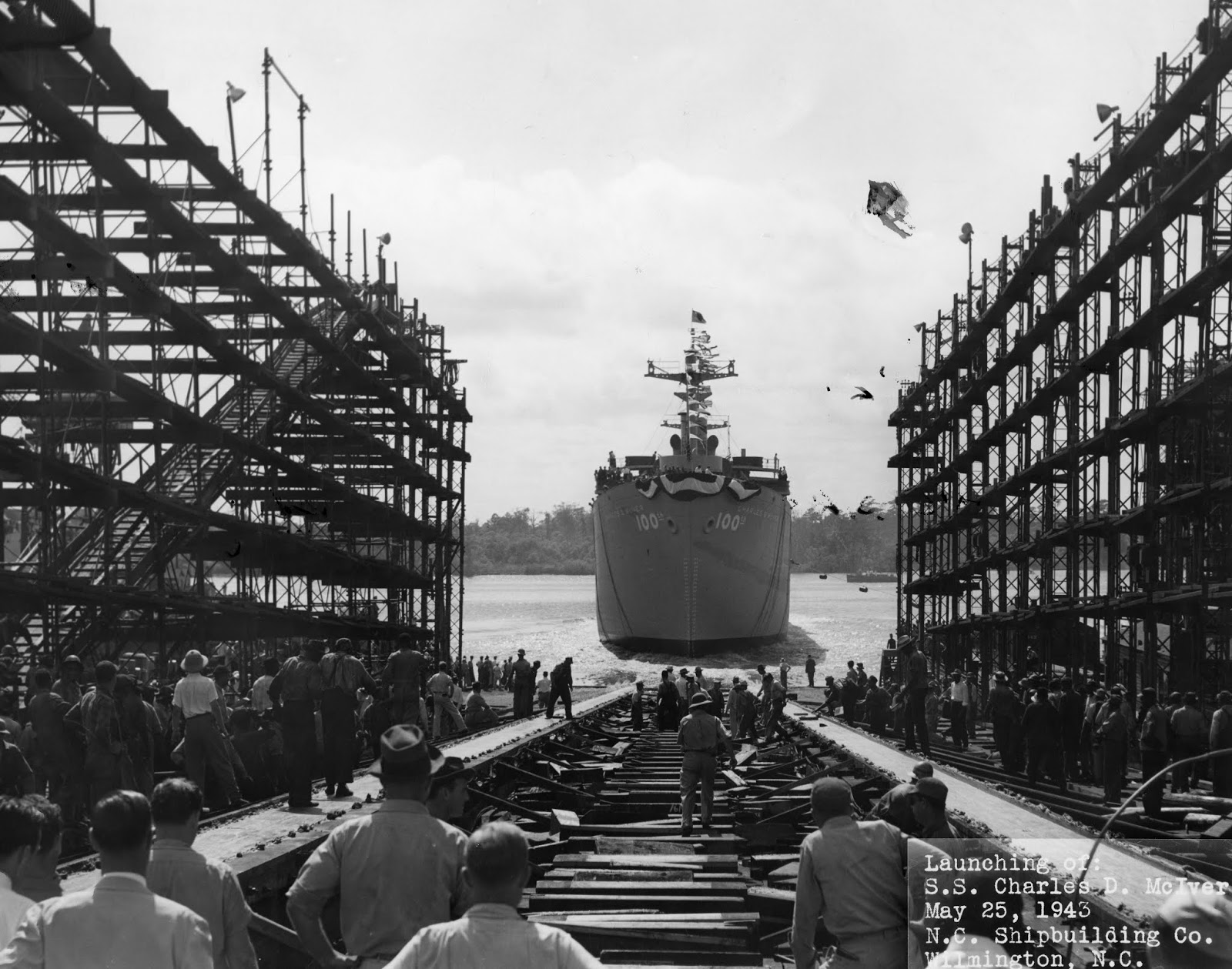 |
| The launching of the S.S. Charles D. McIver** |
Eighteen shipyards built over 2700 ships during the years between 1941 and 1945. Considered the “ugly ducklings” of the naval fleet, the Liberty Ships averaged 441 feet long with a crew of forty-four, holding almost 10,000 tons of cargo in addition to tanks, planes, and ammunition. Built to last only through the war, many of these ships survived, with over 800 incorporated into the United States cargo fleet, and others sold to Italy and Greece. Several ships continued to serve into the 1970s, and currently, two are used as museums. Sadly, the S.S. Charles D. McIver did not fare as well. On March 22, 1945, it sank after striking a mine as it left Antwerp, Belgium. A full rescue was made by a British motor minesweeper and a motor torpedo boat, which rescued the Merchant Marine crew and the armed guard also on board. The S.S. Charles D. McIver was later written off as a total loss.
By Kathelene McCarty Smith
*Image from the Charles D. McIver (Liberty Ship) subject file
** Image courtesy of New Hanover County Public Library, North Carolina Room

2 replies on “The Liberty Ship, S.S. Charles D. McIver”
My father, Joseph Geklinsky, Jr was aboard when she sank. He was a Merchant Marine and only 16 years old at the time!
My father was in the Armed Guard and the SS Charles D. McIver was his first ship. Having enlisted on Aug 28, 1943, at 17 years old, went to boot camp, then gunnery school and then he was stationed at the Armed Guard Center located at 1st Avenue and 52nd Street in Brooklyn waiting for orders. He received his orders to report to the SS Charles D. McIver on Nov 20, 1943 at pier 92 on the west side of NYC. His ship, the SS Charles D. McIver, made quite a many crossings before he was part of the armada that left Southampton England on June 6th, 1944 for the invasion of Normandy France. While crossing the weather was really bad, a French Corvette was going thru the fleet making sure that there was no U-Boats in the area and hit the SS Charles D. McIver broadside and sliced her open. They counter flooded the ship and went back to Southampton England for repairs. The only thing that saved the ship from being ripped in half was that they had corrugated decking in her holds. Corrugated decking was used to make temp airfields behind the Normandy beach head. They returned to Normandy around Aug of 1944 right after Paris fell. My father had a chance to transfer off the SS Charles D. McIver and he did so stating that he has been lucky so far. My father transferred off Jan 17, 1945